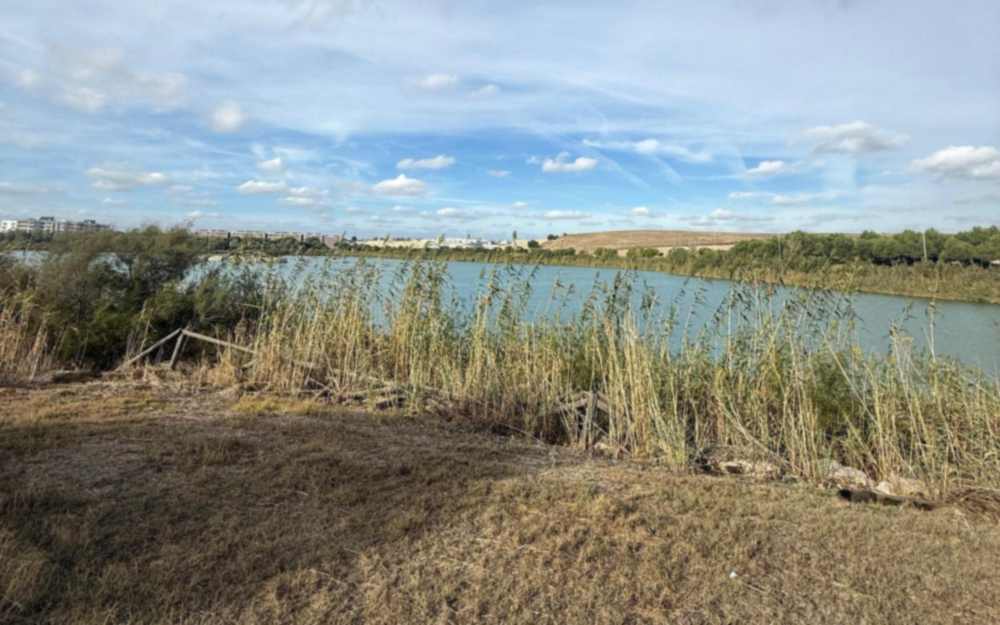
Laguna de Torrox does not appear in the Jerez guidebooks, but it does more for the city than it seems. It stores water to prevent flooding,1 supports birds that are scarce across Europe and is, for the south of the city, the place people go for a walk.
Threatened birds
Red-knobbed coot, white-headed duck and ferruginous duck, among dozens of species.2
A man-made wetland
Before 2002 there was a seasonal lagoon here: it dried out in the hottest summers and, after heavy rain, turned into a flooded area of 10 to 15 hectares.3 Today’s lagoon is a constructed wetland, built to store water and prevent flooding,1 and it is divided into two sections with an island in each.2 It is, above all, infrastructure that protects the neighbourhoods around it.
The park of southern Jerez
As the city grew, the lagoon ended up inside the southern district and became part of the Anillo Verde, Jerez’s green belt.4 Residents use it to walk, run or cycle, families stroll with their children and many come in the afternoon to see the ducks.5 The City Council presents it as a space for family leisure and light exercise, and there is even a residents’ association named after it.6
Who lives on the lagoon
For a lagoon surrounded by housing, it has remarkable diversity. Each habitat attracts different species:
Red-knobbed coot
Fulica cristataEndangered in Spain. Together with Morocco, it is the species’ only stronghold in the Palearctic.8
Easier to see at Torrox since 2024White-headed duck
Oxyura leucocephalaThreatened diving duck, the subject of a national conservation plan.9
Rare at TorroxFerruginous duck
Aythya nyrocaAdded in 2024 to the same national strategy for threatened ducks.9
Rare at TorroxThe plants
The lagoon’s vegetation is simple and almost all along the shore. Reeds and rushes grow in the water and at its edges, and a tamarisk thicket spreads around it.1 Those reed beds shelter the little bittern and the western swamphen, and the tamarisks serve as a stopover for migrating birds.2 Beyond the water, a belt of trees lines the paths;10 in 2016 the City Council replanted 70 pines around the larger lobe, after meeting residents of Torrox and Guadabajaque.11
Beyond the birds
Birds are the most visible life, but not the only one. Fish live under the water and many families come to watch them in the afternoon,5 and the odd hedgehog has been seen in the grass along the shore.7 At dusk the bats come out: the City Council has announced a night event to learn how to recognise the different species.12
Even the mosquitoes in the tamarisks10 have their role. The council’s biodiversity plan treats them as part of the food chain, alongside pollinating insects, and plans shelters for small mammals and insect-eating birds that feed on them.12 Few cities have all this within walking distance of home.
An open-air classroom
That closeness makes it a classroom. SEO/BirdLife has led birdwatching walks around it on World Wetlands Day,3 and the City Council wants it to remain a meeting point for leisure and environmental education.13 Its biodiversity projects include shelters for birds and small mammals, insect hotels, talks and a night event to get to know the area’s bats.12
Value that needs upkeep
All that value depends on maintenance. The wooden fence went some twenty years without care and its renewal was a long-standing demand of residents;13 residents have been asking for more cleaning for years.5 The park’s current condition is documented, photo by photo, on the lagoon’s page.14
Sources
- The video of dozens of carp in Laguna de Torrox: why are they unwelcome? La Voz del Sur, 9 Apr 2025. In Spanish.
- Laguna de Torrox. Birdingplaces, updated 2 Mar 2024.
- Discover the secrets of Laguna de Torrox on a one-off walk for World Wetlands Day. Portal de Cádiz, 25 Jan 2024. In Spanish.
- Laguna de Torrox. Wikipedia (Spanish), accessed 22 Oct 2026.
- Complaints about the state of Laguna de Torrox. La Voz del Sur, 17 Oct 2020. In Spanish.
- The mayor inspects the finished works on the lobe 2 path at Laguna de Torrox. Jerez City Council, 5 Feb 2022. In Spanish.
- Birdwatching: Laguna de Torrox, Jerez de la Frontera. Birdwatch Cádiz, 6 Dec 2022.
- Breeding red-knobbed coots at Las Tablas de Daimiel to bring back this endangered bird. Ecoticias, 13 Mar 2026. In Spanish.
- Strategy for the conservation of the marbled duck, red-knobbed coot, white-headed duck and ferruginous duck. MITECO, Jul 2024. In Spanish.
- Laguna de Torrox. Conoce tus Fuentes, 19 Feb 2022. In Spanish.
- The City Council plans to replant some 3,000 trees across Jerez up to 2019, starting with 70 pines at Laguna de Torrox. Diario Bahía de Cádiz, 3 Jan 2016. In Spanish.
- Projects to improve biodiversity at La Canaleja and Laguna de Torrox. Jerez City Council, 12 Oct 2025. In Spanish.
- Fencing at Laguna de Torrox in Jerez to be renewed after 20 years without maintenance. La Voz del Sur, 5 Oct 2025. In Spanish.
- Laguna de Torrox. Natura Sine Nomine, Oct 2026.